Mold Treatment

How Does The On the Spot Mold Remediation Process Work?

As  a proud member of the NORMI, On the Spot’s Certified Mold Remediation Team has a rigorous process to remediate mold infiltration in your home.

Before you undertake any mold remediation work, it is important that your insurance company is made aware of the problem, and has the opportunity to evaluate the problem before work commences. Failure to provide the insurance company with an opportunity to determine and extent of the problem could fail to pay out. To prevent this our friendly team of customer service advisors at On the Spot are fully knowledgeable in the claims process, and they can and will assist you on the correct procedures to follow. 

My experience with this company was outstanding. Their estimate of procedure and cost was itemized to the last detail. The workers were punctual, friendly and efficient. When the job was almost completed Robert said to us. “Do you have any questions. We want this job to be perfect in your eyes not ours”. Would highly recommend this company and will call them again should the need arise. The last thing they said when leaving was “if you have any questions please don’t hesitate to call us”.
We had a very positive experience with ON THE SPOT business. With the bill they had attached pictures of the job from start to finish. That was great. Try them you won’t be disappointed.

At On the Spot, we work with you to ensure that Mold becomes a historical problem and not one that you will have to face in the future.

Has Mold Invaded Your Home?

Don’t wait—delays can lead to dangerous mold growth. Our emergency response team is standing by to remediate your property.

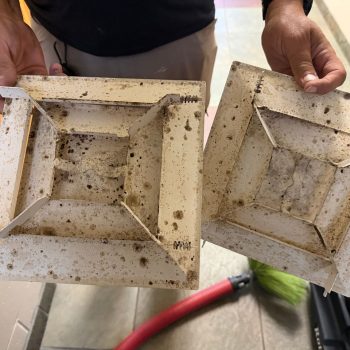
Step 1A damaged refrigerator with mold and deterioration, positioned on tiled flooring among other kitchen items.

Inspection & Protocol

  • Visual inspection and moisture source identification
  • Coordination with third-party assessors (e.g., PRV testing)
  • Development of remediation plan per IICRC S520 guidelines

Containment & Safety

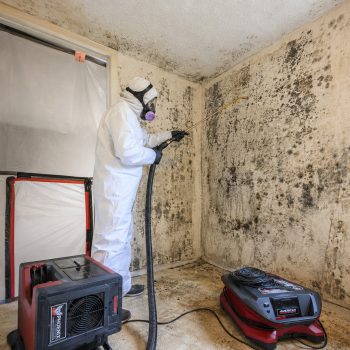
    • Full containment setup (poly barriers, zipper doors)


  • Negative air pressure using HEPA filtration
  • Protection of unaffected areas

Mold Removal & Cleaning

  • Removal of mold-contaminated materials
  • HEPA vacuuming of all affected surfaces
  • Detailed cleaning of structural components

Air Filtration & Scrubbing

HEPA air scrubbers to remove airborne spores
Continuous air filtration during remediation

Decontamination & Treatment

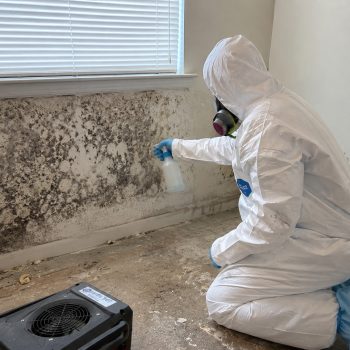
Antimicrobial and biocide application
Cleaning and sanitizing of affected areas
Surface wiping and detailed cleaning

Advanced Treatment Options

ULV fogging (fine particle distribution for coverage)
Electrostatic fogging (charged particles for full surface adhesion)
Ozone treatment (odor and microbial reduction where appropriate)

Drying & Moisture Control

Dehumidification to prevent regrowth
Ventilation improvements to control humidity

HVAC System Cleaning

Air duct cleaning
A/C coil cleaning
Removal of contamination from HVAC systems

  • Selective Demolition

    Drywall removal
    Baseboard and trim removal
    Insulation removal
    Removal of other porous contaminated materials

  • Post-Remediation
  • Detailed cleaning for clearance readiness Coordination with third-party testing (PRV) Final walkthrough and documentation

A Basic Explanation of Mold and The Problems It Can Cause

Mold is an issue that most homeowners will have to deal with at some point during their lives, and yet the overall understanding and knowledge that the general public has is relatively small compared to numerous issues. In many ways, this is quite surprising given the prevalence of mold in the southeast region of the U.S., and although the intention of this article is not to make you mold experts, we believe it is important to have at least a basic understanding of the problem you may be facing.

Problem 1 – Mold Can Be Anywhere
The first issue that needs raising is that unlike many other maintenance problems that occur inside a property, mold is not necessarily going to stick its head out and let you know of its existence. Mold can grow anywhere, and prefers the dark, damp depths of a property, in a lot of situations this may mean areas such as the wall cavity behind showers, where it can remain undiscovered for long periods of time due to slow leaks.

Problem 2 – Mold Can Cause Health Issues If Left Untreated
Has a member of your family recently started to suffer from migraines, coughs or sore throats? Perhaps they have been experiencing breathing problems. Although the correct and proper procedure and advice would be the visit the doctor, it may well be beneficial to have your property tested for mold. These type of illnesses can be caused or exacerbated by mold spores, which are tiny and transported in the air. Professional mold testing can assess the quality of your air, and ascertain if you have a problem long before any physical signs of mold may become apparent.

Problem 3 – How To Identify All of The Issues
In most cases, Mold is not the problem it is the symptom. Mold can only grow when it has food, the correct temperature, and moisture. Without all three of these components, Mold is unable to grow. Subsequently even though in certain situations such as in a bathroom, you may be able to see and remove the mold, by wiping it away, the mold will quickly return as you have not dealt with the underlying problem. Consideration also needs to be given to the types of material stored in the locations where the problem is occurring; Although mold can grow on virtually any surface, it prefers porous and permeable surfaces such as wood, drywall, paper, fiberglass, upholstery, and leather.